
Thursday, 16 January 2014

Week Two Reflections


Dear all,

In general week 2 was more fruitful.

My first reflection is here is the best search engine I found " http://funnylogo.info/engines/Google/Red/ouarda%20khouni.aspx" try it and you wont regret as all you will have is a smile. Just for fun.

Now, let's start to be serious.

What I did and learnt

            First I started by having a look at readings and week assignments where I skimmed articles about  writing course objectives and browsed through Noodletools that represent a great treasure of knowledge about search engines. I appreciated reading the following links:

1. Classifying objectives

 http://edtech2.tennessee.edu/projects/bobannon/classifications.html#bloom
 http://www.edpsycinteractive.org/topics/cognition/bloom.html

This  link is about blooms taxonomy of objectives which is a crucial issue in lesson planning because as teachers we should classify objectives because the type of objectives attempted dictate the selection of instructional methods, media and evaluation used in the lesson. Objectives may be classified according to the primary learning outcomes that take place. (said by the author of the article on same link). According to this taxonomy, objectives are classified into three types: the cognitive domain includes objectives related to information or knowledge, the psycho-motor domain, including  objectives that require basic motor skills and/or physical movement such as construct, kick or ski and the affective domain  includes objectives pertaining to attitudes, appreciations, values and emotions. From the reading also, we can know what kind of verbs we can use to describe the learning outcome or learners' behaviour which is very important to determine their type and make them measurable. 

2. Writing objectives

http://ets.tlt.psu.edu/learningdesign/objectives/writingobjectives/

What I really appreciated in this article is tackling the issue of writing objectives from a practice perspective. The examples given in detail helped us a lot in revising our previous objectives and rethinking about our problems and mistakes. It was a great experience for me. Also the list of references provided maybe served for further research. 


3.  How to Write Learning Objectives that Meet Demanding Behavioral Criteria


 http://www.adprima.com/objectives.htm

In this  article writen by Dr. Bob Kizlik, the importance of objectives is well stated and explained.

and that was expressed in one sentence said by the author :


The purpose of a learning objective is to communicate" ( Kizlik 2013)

               Therefore, a well-constructed behavioral learning objective should leave little room for doubt about what is intended. A well constructed learning objective describes an intended learning outcome and contains three parts, each of which alone means nothing, but when combined into a sentence or two, communicates the conditions under which the behavior is performed, a verb that describes the behavior itself, and the degree (criteria) to which a student must perform the behavior. If any one of these three components is missing, the objective cannot communicate accurately.
Therefore, the parts of a learning objective are:

1. Conditions (a statement that describes the conditions under which the behavior is to be performed)

2. Behavioral Verb (an action word that connotes an observable student behavior)
3. Criteria (a statement that specifies how well the student must perform the behavior).


Another thing I've just learnt is the revision of Bloom's Taxonomy which can be represented in this image. 
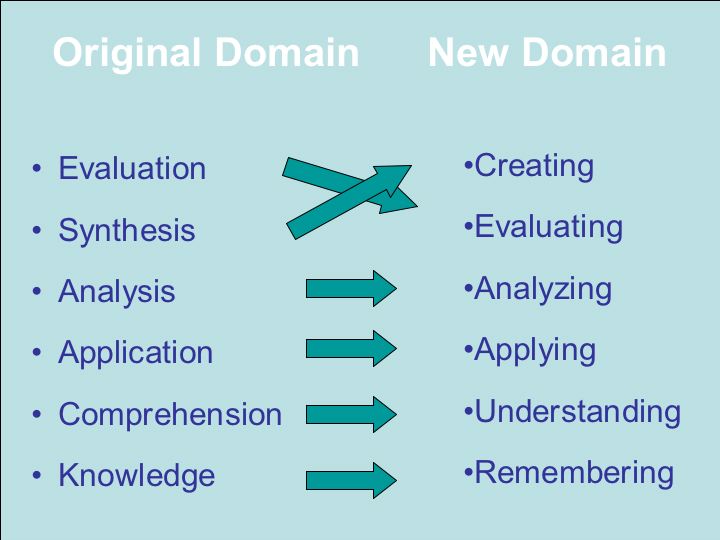
Bloom's Revised Taxonomy
                          (Retrieved from http://www.nwlink.com/~donclark/hrd/bloom.html)

So what I learnted from week 2 is: it was a means to activate my schemata and bridge the gap between my prior knowledge and new things I learned during the course.  Further, the course started to refresh my motivation and encourage me to express my ideas, thoughts and reflections which I didnt do since a long time.


What I may apply in my teaching

As  a teacher, I'm thinking about three main things:

- To make further research and write a paper about demystifying the notion of objectives to clarify things for my colleagues and students.
- To organize a workshop on that and help teachers who still have problems to write objectives.
- I will revise all my lesson plans
- I will use blog assignments and consider them as a part of the course to train my students to use blogs and web activities and motivate them to use new techniques of learning.

Finally I will inform my students and colleagues about new search engines that they may use easity instead of Google.

Looking forward to hearing from you and reading your comments and reflections

Regards

Warda in Arabic (or Rose in English)


Tuesday, 14 January 2014

Week Two Motivation


 Dear all,

           Talking about my class and conditions made me little sad but I never lose motivation and the latter is my cup of tea. I say always to my students the motivated learners and teacher are not those who don't have any kind of problem but those who have serious problems but still face them and learn.this principle makes me eager to learn and improve myself and skills waiting for the day of change. I started to make change in my teaching practice, I couldn't work on the conditions, materials  and the setting so I shifted my focus to my lesson plans, teaching strategies, references and activities. One of my favourite sayings :  "if your learning setting or environment doesn't motivate you, motivate yourself"   for that I try always to be updated and to inform my students and colleagues about new technologies and findings as I believe that little is better than nothing.


Now I go back to week 2 beginning,

I appreciate the ABCD objectives approach and it is my first time that I read about it though I read many articles about writing learning objectives and outcomes. However, I recommend a few articles  that I read since 2010 about types of objectives, Bloom's taxonomy and smart objectives.

Smart objectives
http://www.iom.edu/About-IOM/Making-a-Difference/Community-Outreach/~/media/Files/About%20the%20IOM/SmartBites/Planning/P1%20SMART%20Objectives.ashx 

Writing Objectives Using Bloom's Taxonomy

 http://teaching.uncc.edu/articles-books/best-practice-articles/goals-objectives/writing-objectives-using-blooms-taxonomy

Writing Learning Objectives: Beginning With The End In Mind
 http://www.oucom.ohiou.edu/fd/writingobjectives.pdf
Writing learning objectives
 http://www.uwo.ca/tsc/graduate_student_programs/pdf/LearningObjectivesArreola.pdf
Learning objectives (most interesting by Nottingham university)

http://www.nottingham.ac.uk/medical-school/tips/aims_objectives.html
I hope you appreciate the post and readings 
Regards
Warda


Saturday, 11 January 2014

What kind of blog is it ?

Creating a blog is like designing a lesson plan, where we are not supposed to give only the core content but the whole framework with particular standards and norms. like lesson plans, blogs must include instructions and objectives.

As teachers and tutors, our blogs must start with use tips related to the course, students, and the blog itself being:
- blog type, is it a reading blog, writing or journal blog, reflective blog or language practice blog ?
If it a reading blog students are not supposed to register or write comments and teachers are not asked to correct or comment on it. If it is a journal or writing blog, teachers should take control over all what students write or comment especially if it is a part of the peer assessment or a course journal. in case it is a fun or leisure blog, that would be another story to deal with.
- blog objectives, is it designed as an extra support or it is a part of the course.
- blog content should be explained to participants or blog users
- blog norms should be clarified at beginning and given space to be shared and discussed.. Many people get shocked having strange posts or comments, so they give up and leave everything. In this case either we explain or post norms or restrict comments to members  who have access to the blog.


Waiting for your comments to improve our understanding of blogs !!

Thursday, 9 January 2014

Week One Reflection

I start my reflection by suggesting this article to read about blogs and wikis

http://www.ascd.org/publications/educational-leadership/feb09/vol66/num05/Learning-with-Blogs-and-Wikis.aspx

As I mentioned on my Nicenet post the issue is not how to create a learning blog but how to make it survive and keep yourself motivated to go on !! 

What I liked is sharing and clarifying rubrics from beginning. I think the best idea here is to introduce blogs as a part of the course tasks and assessment rubric because many of us are busy and have many work duties that may prevent them from doing so.

I had experience with blogs since 2010 but failed because I teach large classes and I had no responses from neither students nor colleagues and I was not allowed to make it as a part of the course so I can post assignments or ask them for reflection because the majority of our students dont have internet access at home or in campus. However, I felt unjust to discriminate them and deal only with a few students who do.  


Wednesday, 8 January 2014

Dear all,

This blog is created to reflect on the Oregon  University E teacher program.

Looking forward to hearing from you and reading your comments


Regards
WARDA